September 30, 2006

Grabbing a late lunch... in MEXICO (Baja / Laja, part 1)

I had a work-related meeting on Friday in San Diego, so Lav and I decided to make a short getaway weekend out of it. While searching for things to do and places to eat, I came across two words that have since become magical to us: Laja Restaurante.

Laja is a quaint restaurant in Baja California featuring pristine local, seasonal ingredients, located about 10 miles north of Ensenada in the heart of the wine country of Guadalupe Valley...

Wait a second! Wine country in Mexico? That's right. Mexico was actually home to the first vineyard plantings in North America; the cultivation of wine grapes began over 400 years ago, and the region has seen a real renaissance of serious wine-making efforts over the past decade.

Good food and wine? That was all we needed to hear to rent a car and cross the border.


With all the information on the internet, there is a surprising dearth of commentary about travel and road conditions for Mexico’s highways. We had no idea how long the trip would take in its entirety, with the biggest question mark being the potential for an excruciating 3+ hour wait to cross back into the U.S. at San Ysidro. We decided to optimistically aim for this schedule:

  • 9 am: Leave San Diego for Tijuana; head for Ensenada on Route 1
  • 11 am: Arrive in wine country and visit L.A. Cetto, Monte Xanic, and Chateau Camou
  • 1:30 pm: Lunch at Laja (their earliest reservation)
  • 6 pm: Cross the border at Tecate via Route 3 (2 lane highway)
  • 7 pm: Return the rental car in San Diego and catch our 8:15 pm flight back to Oakland

Could it be done? With only 2 hours allotted to get to Tecate and wait through the line at the border, it seemed like a 50/50 chance we’d miss our flight.
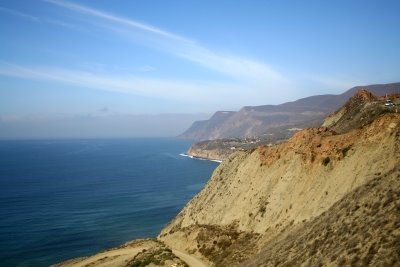
The border crossing into Mexico was ridiculously easy. There’s no checkpoint; you just drive on through as if you’re driving into Nevada. Of course, within 47 seconds of crossing the border, we missed our exit and were lost for about 5 minutes in the outskirts of Tijuana. Nice move. Somehow, Lav pointed us back onto the right freeway (you’d think that following a numbered highway would be easier), and we got back on track. The coastal drive on Route 1 is pretty nice, with some spectacular views that are reminiscent of driving Highway 1 in California.
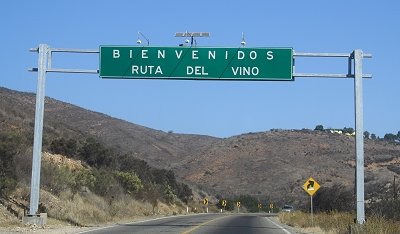

The rest of the ride was smooth sailing, with just three quick toll crossings along the way. The roads are in great condition, and it basically felt like driving in the U.S., but with lower speed limits (I’d read too many warnings about getting stopped for speeding by the Mexican police to test the speed limit). About 5 km north of Ensenada, we veered northeast onto Route 3 and were soon greeted with this glorious sign. Roughly translated, to me it said “Good things await ahead.”
The wine country in Mexico is like a mellowed out version of early Sonoma… small wineries along the ruta del vino, unspoiled and uncluttered by the madness of weekend tourists. Our first stop was L.A. Cetto, Mexico’s largest wine producer (www.cettowines.com), which is actually located at the northern-most end of the wine road, near the 73 km marker.
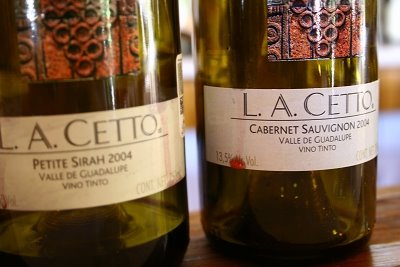
We sampled their Chardonnay, Sauvignon Blanc, Petite Sirah and Cabernet Sauvignon… pretty interesting how the climate here can accommodate quite a wide array of varietals.
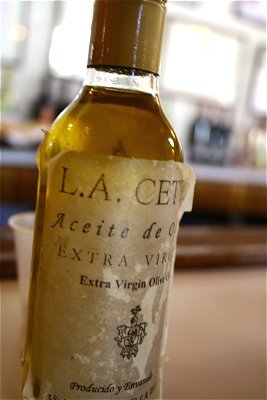
More than the wines here, we were drawn to the extra virgin olive oil made from the winery’s estate-grown olives. Smooth and rich, with very low acidity and only a faint herbaceous note, Cetto’s olive oil is remarkably tasty stuff.
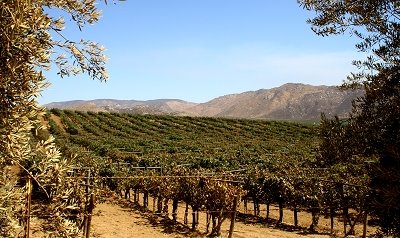
As we headed off to the next winery, we couldn’t help but notice how similar the landscape is to our own wine country. It really is beautiful and peaceful here.
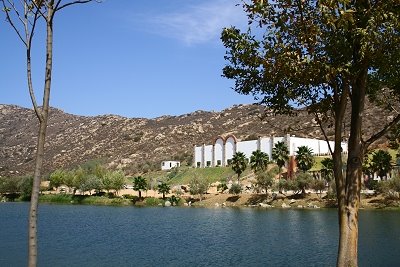
We backtracked on Route 3 and arrived at Monte Xanic (www.montexanic.com), a facility tucked into the hillside. As their website explains, “Xanic” is a native Cora Indian word meaning “the flower that blooms after the first rains.” A fitting name for a winery making some special wines.
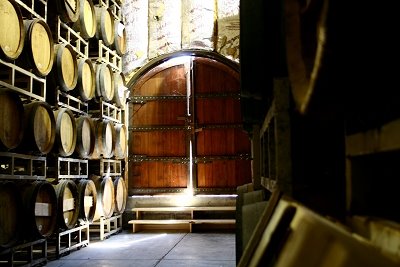
From the parking lot, we entered through a beautiful arched wood door, which led directly into one of the barrel storage rooms.
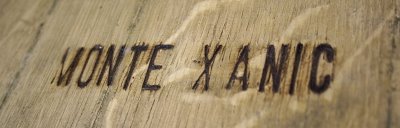
We had the opportunity to taste 11 different wines while sampling their estate-grown olives. The quality of these wines across the board was quite high. The most interesting aspect for me was observing the differences in vinification styles here, mostly in the white wines. The chardonnays tend to have substantial oak (although the winery also makes a completely un-oaked chardonnay as well). The sauvignon blanc is completely different; much more tart and citric, and with a hint of underlying savory/vegetal character... but with oak as well. As Ezrael, one of the managers of the winery explained, they are still experimenting with which varietals will thrive in the valley.
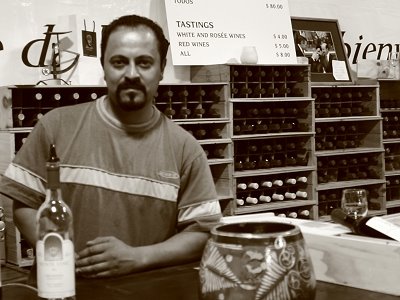
This is Jose, our new friend who was hooking us up in the tasting room. Chenin Blanc reportedly does very well in the Guadalupe Valley, which makes sense, since it can thrive in warmer climates than most other grapes. Monte Xanic’s version exhibits a tropical, Viognier-like nose of papaya and stone fruit, opening up to a simple, but delicious palate of honey, peaches and lemon rind. They blend in 5% Colombard, which adds a unique element of acidity not typically found in Chenin Blanc. Ezrael came by and gave us a special taste of their single varietal Malbec (which the owner had opened earlier for some friends) which was excellent. Dark and brooding, the Malbec had a firm core of dark fruit and plum, a luscious mouth feel and a medium-long finish evoking just a hint of earthy spice at the end (fennel seed?). Really, really nice.

We were having such a good time at Monte Xanic that it was 1:30 pm before we knew it… so we had to skip the well-regarded wines of Chateau Camou, which was just up the road. That’s alright; that just gives us another place to try next time. It was time to eat.

(to be continued...)

September 28, 2006

A16: pizza excursion #2 at a real gem

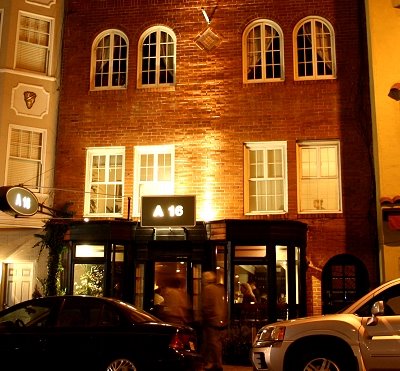
Still in the mood for a great thin-crust pizza, Lav and I went to A16 in the Marina district. Chef Nate Appleman, a certified pizzaiolo, took over the helm from Christopher Hille (now a private chef in New York) earlier this year. Hille said the following of Appleman in the Chronicle: "Nate has been instrumental in A16's success since the day it opened. He possesses a tremendous talent for regional Italian cooking, has the highest standards for quality and is making the best salumi in America today."


We started with an incredible -- and I mean every bit of that word -- zuppa of zucchini, mussels, beans and grilled bread. The dish had six of the most fantastically plump and fresh mussels we've had in a long time. The broth was rich and velvety; the grilled bread unctuous from the char and high quality olive oil as it soaked up the broth. The outragous depth of flavor of this rustic, but refined dish had us exchanging looks of wonder and satisfaction as we took each bite.

Next, we had the house-cured bresaola, which is made of choice cuts of beef that are seasoned and spiced, then air-cured. It was served thinly sliced, dressed with just a squeeze of fresh lemon. Much leaner than other italian cured meats, but with a remarkably focused and intense flavor. Silky and succulent, it practically dissolved on the palate. It was stunning... this was truly great salumi.


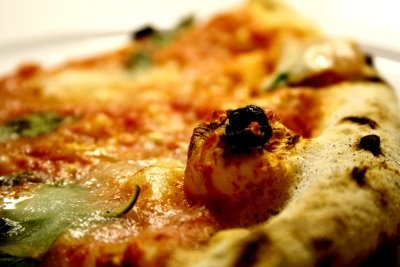
Then, the pizze margherita. A wonderfully toothsome crust that was just lightly cripsy on the very surface (including the bottom of the pizza) while still being pliable and elastic -- and not at all soggy in the center. The pizza only used regular mozzarella, so the cheese wasn't quite as rich, but still delicious. The sauce was a picture of simplicity: bright acidity and just a light addition of basil to enrich the body... and perfectly proportioned.


Finally, a soulful dish of buccatini with clams, olives, blistered cherry tomatoes and fried bread crumbs. The buccatini was perfectly al dente, and the crunch of the fried bread crumbs in the background created a unique synergy. Texturally magnificent.

Just when we thought we were done, we convinced ourselves into sharing a honey semifreddo made with a rich cream and served with an almond shortbread cookie and macerated raspberries and figs. Maybe a little bit of an excessive finish to a fantastic meal.

A16
2355 Chestnut Street
San Francisco, CA
415.771.2216
www.a16sf.com


A16 on Urbanspoon

September 24, 2006

Butter and licorice for dinner... toying with molecular gastronomy

Lav and I were having Vijay, Meg and Victor over for dinner last night, so we trolled ourselves over to Ver Brugge and Berkeley Bowl for all the essentials. I've been reading about Thomas Keller's butter poaching technique for lobster (Vijay noted that a similar preparation was used by Ron Siegel when he won "Battle Lobster" on the original Iron Chef in October 2000) and the merits of the beurre monte.


The science behind the technique seems solid -- if you heat a protein to a high temperature, it will seize up and toughen; keep the temperature low, and the meat will remain tender. I decided to try and adapt the technique for beef tenderloin. If medium-rare is between 130 and 135 degrees F, then slow poaching in butter at that temperature should theoretically yield an incredibly tender steak. I added some aromatics (shallot, bay leaf, garlic) to my poaching liquid in the hopes of imparting a subtle flavor in the process.

-------------------------------------------

GRANITA
grapefruit, lime, mint, verget du sud marsanne

PRAWN CEVICHE
red onion, cucumber, heirloom tomato, avocado, cilantro

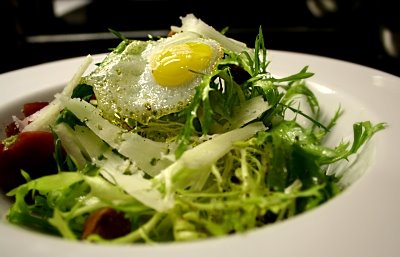
SALAD OF FRISEE, MANCHENGO AND FILBERT
japanese black cherry tomatoes, warm bacon dressing

SEARED SCALLOP
andouille, kabocha puree, coconut foam

GRASS-FED BEEF TENDERLOIN POACHED IN BUTTER, QUICK SEAR
potato puree, melted fennel, st. andre and bleu cheese béchamel, licorice reduction

ROSE WATER CRÈME CARAMEL
golden raspberries, baby kiwi

-------------------------------------------
The granita was intended to awaken the palate and appetite, and to provide some initial acidity as a complement to the roussanne we were drinking. There was also a spash of marsanne in the granita... I wanted to give Vijay a bit of insight into both of the wines he was picking up that night.
For the prawn ceviche, we went with a traditional combination of lime, cucumber, and red onions. I also added chunks of heirloom tomato for sweetness and cilantro to mellow the acidity of the lime and freshen the combination. Since the prawns were quite meaty, I also threw in some soft avocado and a drizzle of a smooth, buttery extra-virgin olive oil to add a nice roundness.

At this point, we opened up the 2002 Paul Hobbs chardonnay, Russian River Valley, that Vijay graciously provided. This was a lovely California-style chardonnay that exhibited balance even with the strength of its fruit core. More importantly, it led to an amazing pairing later on in the meal...

Originally, I wanted to serve a spinach salad with a warm bacon vinaigrette. Unfortunately, with the whole e. coli situation going on, baby spinach wasn't an option. So we picked up a bunch of frisee, which has the texture and bite to hold up to the bacon. We also found these incredible japanese black cherry tomatoes at the market, whose depth of flavor mirrored their deep ruby/violet color, while still maintaining some acidity. The manchengo shreds are there for depth of flavor, the hazelnuts connect to the hint of nuttiness in the manchengo, and the quail egg creates one final small layer of rich creaminess. A nice pairing with the chardonnay.

This scallop dish was my favorite of the night because I thought it had the best marriage of component flavors, with the added bonus of being a PERFECT match with the chardonnay. Pristine scallops have an inherent sweetness, with a nuance of the sea. This affords a great opportunity to capitalize on both sweet and savory components. In this dish, the seared scallop is scored on one side (for visual appeal and textural mouthfeel after caramelization) and paired with a kabocha squash puree, seasoned with a pinch of cinnamon, allspice, and cayenne. A dice of andouille is seared in the pan at the same time to add richness. The scallop is topped with spindle-like onion sprouts, which have the most delicate essence of onion aroma.

The most important component of the dish, however, was the coconut foam (not pictured). The rich depth of the sweet coconut aroma and flavor truly unified the sweet and savory elements of the dish, substantially elevating it. The savory unctiousness of the scallop and andouille, paired with the sweetness of the kabocha puree and the tropical notes of the coconut foam were truly an unexpectedly ideal marriage with the Hobbs chardonnay. For me, the combination was absolutely seductive and alluring.

Now for the experimental dish of the night. Grass-fed (leaner and meatier) filet mignon, poached in scented butter at 140 degrees for 20 minutes, then flash seared on one side for textural contrast. The licorice reduction was equally experimental; it was done to play off of the melted fennel served on top of the steak, but with an exponentially more intense flavor concentration. I was afraid that the flavor wouldn't match well, but there was remarkably little clash, and even those who don't like licorice (Lav) enjoyed the combination. Unexpectedly, the strength of the licorice actually opened up the silky texture of the filet.

The potato puree was made of creamer potatoes for natural sweetness and creaminess. The finish on the steaks was a bechamel made with st. andre and bleu cheese -- just some extra decadence, with the hint of sharpness from the bleu cheese as a classic contrast. Everthing about this dish reflects the meat's tenderness and silkiness. The butter poaching worked as intended, and the steak was just under medium-rare, with a velvety mouthfeel. We paired it with a 1997 Clos du Val cabernet, which was lightly earthy and elegant, but ended up being a little lighter-bodied than what was needed for the dish. Perhaps a young Pomerol from a hot summer vintage would have been the right match...

A well-made creme caramel is one of my favorite desserts. The rose component was inspired by Citizen Cake's use of rose water in its creme brulee. The aroma can be subtle, but it is such a good match with vanilla. Here it is served with a candied rose petal, golden raspberry and baby kiwis -- which we'd never seen before! The kiwis were fantastic... but the creme caramel was sweeter than I had intended.


Meg and Victor brought some delectably decadent truffles from XOX (http://www.xoxtruffles.com/) to finish off the meal. What a great way to cap off the night. The whole evening reminded me why I enjoy cooking. Sure, it's great when the dishes turn out as hoped, or when terrific food/wine pairings are discovered, but really, the most important part to me is creating a reason for friends and loved ones to get together and enjoy each other's company. There's really no better reason to do it. And Lav and I are truly blessed for each of the friends and family members who enrich our lives.